
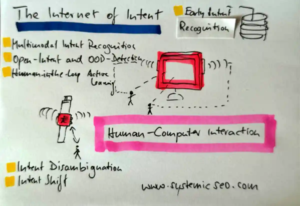
Human-Computer Interaction on the Internet of Intent
Intent Recognition in the field of Human-Computer Interaction
How does human-computer interaction research and technical literature define, model, and process intent recognition across conversational, multimodal, and interface-driven environments?
Intent-Based Design Paradigms
User interface design shifts from static menu navigation toward direct goal expression, where systems dynamicize response pathways based on inferred intent. Replacing fixed UI paths with intent processing alters how user goals translate into system execution.
Multimodal Intent Recognition – Definition
Heterogeneous data streams including speech, text, gestures, gaze, and physiological signals are combined to establish a holistic representation of user goals. Fusing these modalities bridges semantic gaps that occur when analyzing single input streams in isolation.
How to utilize Vector Proximity and Randomized Intent Vectors?
Intent recognition models convert input signals into intent vector spaces and calculate spatial proximity relative to randomized vector distributions. This vector proximity mapping establishes decision boundaries for classifying complex user goals without manual rule setting.
What is Intent Disambiguation ?
Intent Disambiguous user inputs are resolved by integrating interaction context, structural domain knowledge, and user preference histories. Contextual filtering reduces candidate interpretations to identify the user’s specific target intent.
Early Intent Recognition
User interactions during partial task execution are analyzed via inverse planning and theory-of-mind algorithms to infer latent goals before action completion. Predicting intent early reduces interaction latency and allows proactive system assistance.
Open-Intent and OOD Detection
Out-of-distribution (OOD) classification mechanisms identify user requests that fall outside defined intent taxonomies. Contrastive learning and feature representation separation distinguish known domain intents from novel user inputs.
Conversational Dialogue Parsing
Natural language understanding pipelines and parameter-efficient fine-tuning convert unstructured user dialogue into structured intent classes. Adapting foundation models like BERT or LLMs allows systems to map natural language directly to actionable system commands.
Physiological Signal Processing
Electroencephalogram (EEG) readings, eye movements, and motion tracking capture implicit user states for hands-free intent recognition. Feature extraction and decision-level signal fusion translate physiological activity into explicit control intent.
Human-in-the-Loop Active Learning
Iterative feedback loops incorporate human intervention on low-confidence or boundary intent samples. Expert labeling during active system operation updates model parameters to improve class separation in complex scenarios.
Classification Accuracy and Macro-F1
Performance of intent classification architectures is evaluated through accuracy and Macro-F1 scores across standardized dialogue datasets like SNIPS and ATIS. These metrics quantify recognition precision across balanced and imbalanced intent categories.
There are corrective human-computer interaction loops. Who knows about it, can use it.
Assuming intent recognition is a one-shot classification task leads to brittle systems that fail during real-time goal evolution and error recovery.
You don’t find these informations about Human-Computer Interaction often on the web
- Implicit Intent Recognition: The Public discourse prioritizes explicit user commands and multimodal sensor feeds, overlooking unstated goals inferred passively from context and behavioral cues. Systems fail to anticipate subtle or indirect user goals, forcing users into continuous explicit prompting.
- Research on Implicit Intent Recognition Method Based on Prompt Learning
- https://www.researchsquare.com/article/rs-1891913/v1
- https://www.researchsquare.com/article/rs-1891913/v2
- Intent Shift: Models are evaluated on isolated interactions rather than continuous tasks where user objectives evolve over time. Interfaces lock users into obsolete action pathways when their underlying goals pivot during multi-step workflows.
- Adapting to the Shifting Intent of Search Queries
- Dual-Process Theories, Cognitive Decoupling and the Outcome-to-Intent Shift: A Developmental Perspective on Evolutionary Ethics
Conversational Repair
- Discourse treats misclassification as a binary failure state rather than an expected interactional phase requiring structured recovery moves.
- Users lack lightweight interactional mechanisms to correct system misinterpretations without restarting the task.
- Contextualizing Conversational Strategies: Backchannel, Repair and Linguistic Alignment in Spontaneous and Task-Oriented Conversations
Explainable Intent Recognition (Assumption, tbv. in research)
Research emphasizes raw classification metrics like Macro-F1 over user-facing interpretability of inferred intentions.
Users cannot verify or understand why a system inferred a specific intent, decreasing user trust and control.
Wikidata: https://www.wikidata.org/wiki/Q117327134
Article created: 07.09.2026 15:44